Lawn Insect Control in Montgomery, AL: Full Guide
In Central Alabama, insects can undo a season of good lawn care in a matter of days. Armyworms strip a lawn overnight. Grubs hollow it out from below all summer. And our long warm season gives every pest plenty of time to do its work. The good news: lawn insect damage is very treatable — if you catch it early and use the right approach for the right pest. Here’s what to watch for in the Montgomery area, when to treat, and how prevention programs keep you ahead of the damage.
The Insects Doing the Most Damage in Central Alabama
Four pests account for the vast majority of insect damage on Montgomery-area lawns. Each one works differently, on a different schedule, and needs a different response — which is why “spray for bugs” isn’t a strategy.
Armyworms: The Overnight Destroyers
Armyworms are the most dramatic lawn pest in Alabama. These small caterpillars feed in large groups and can turn a green lawn brown seemingly overnight — damage appearing in a day or two during late summer is the classic sign.
They’re most active from July through October, peaking in August and September, and they prefer lush, well-fertilized grass — the nicest lawns often get hit first. Bermuda is a favorite target.
The telltale test: mix a tablespoon of dish soap in a gallon of water and pour it over the edge of the damaged area. If armyworms are present, small greenish-brown caterpillars surface within minutes. Birds flocking to the lawn are another clue — they’re feasting.
Treatment is straightforward if you act fast: a labeled insecticide stops them quickly. The danger is delay. Ignore armyworms for a week and they can take an entire lawn; catch them in the first day or two and the grass usually recovers fully.
White Grubs: The Underground Eaters
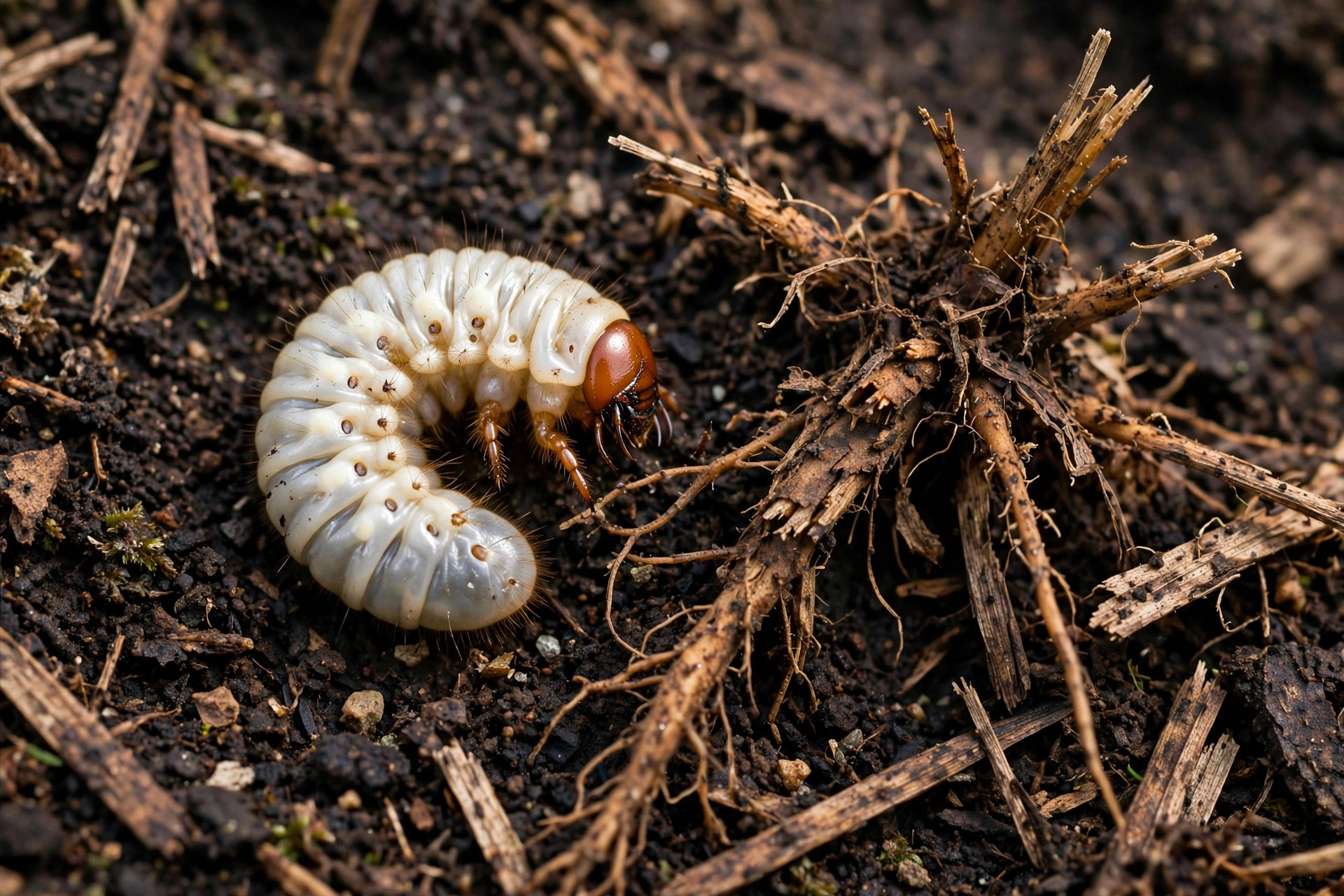
White grubs — the C-shaped larvae of Japanese beetles, June bugs, and chafers — feed on grass roots underground through the summer. Unlike armyworms, the damage is slow and sneaky: thinning, browning patches that gradually expand, turf that feels spongy underfoot, and sections that roll back like a carpet because the roots are gone.
Wildlife often tips you off before you notice the grass. Armadillos, raccoons, skunks, and flocks of birds tearing at the lawn are digging for grubs — if your yard suddenly looks like it’s been rototilled in spots, grubs are the likely reason.
The critical timing fact: preventative grub control must go down in early summer (June–July), before eggs hatch. Once grubs are large and feeding heavily in late summer, preventative products lose effectiveness and you’re left with curative options that are less reliable and more expensive. This is the single most timing-sensitive application in lawn care — miss the window and you’ve missed the year.
To check for grubs, peel back a square foot of turf at the edge of a damaged area and count. More than a handful of grubs per square foot warrants treatment.
Mole Crickets: The Tunnelers
Mole crickets tunnel just under the surface, severing roots and pushing up little mounds of soil. The damage looks like thinning, irregular brown areas — often with visible raised tunnels you can feel underfoot. They’re a particular problem in sandy soils, which parts of the Montgomery area have.
They’re most active in spring and early summer when the nymphs are young and most vulnerable to treatment. Adult mole crickets are tougher to control, so early-season timing matters — another case where the calendar decides the outcome.
Fire Ants: More Than a Nuisance
Fire ants don’t eat grass, but their mounds smother it — and in Central Alabama, they’re everywhere. Beyond the lawn damage, they’re a genuine safety issue for kids and pets. A bad infestation can mean dozens of mounds across a single property.
Control works best as a two-step approach: broadcast bait across the whole lawn in spring and fall, which ants carry back to the colony, plus individual mound treatments for immediate knockdown. Spot-treating mounds alone never solves the problem — the colonies keep expanding underground.
Curative vs Preventative: The Core Decision
Just like with weed control and disease, insect control splits into two philosophies:
Preventative applications go down before the pest is active — grub prevention in June, fire ant bait in spring and fall. You spend money without seeing a single bug, and in exchange, you never see the damage either. For grubs especially, prevention is dramatically more effective than cure.
Curative treatment responds to active damage — armyworm spray in August, grub treatment when turf is already rolling up. It works, but you’re always playing catch-up, and some damage is already done.
The smartest programs combine both: preventative applications for the predictable threats (grubs, fire ants), and rapid-response capability for the unpredictable ones (armyworms). That’s the structure that keeps lawns intact through an Alabama summer.
What a Professional Insect Control Program Looks Like
A solid insect control program in the Montgomery area typically includes:
- Early-summer grub prevention applied at the right rate and watered in properly — the timing-sensitive cornerstone
- Spring and fall fire ant bait broadcast across the property, with mound treatments as needed
- Monitoring through the season — a technician on your property every few weeks is far more likely to spot the first signs of armyworm activity than a homeowner glancing from the driveway
- Rapid response when outbreaks hit — armyworms can’t wait two weeks for the next scheduled visit
Ask any provider how they handle armyworm calls between scheduled visits. The answer tells you whether you’re buying a real program or just a spray schedule.
When to Call for Help
Call a professional if:
- Brown damage appeared suddenly over a day or two in late summer (likely armyworms — speed matters)
- Turf pulls up easily with eaten roots (grubs — and check whether you’re still in the treatment window)
- You see extensive tunneling or soil mounds (mole crickets)
- Fire ant mounds keep coming back despite store-bought treatments
- You’ve had grub or armyworm damage two years running (you need prevention, not another rescue)
One caution about DIY insecticides: more is not better, and the wrong product at the wrong time wastes money while the pest keeps feeding. Grub products applied in September, for instance, mostly miss the window — the grubs are too large and the timing is wrong. Correct product, correct rate, correct timing: that’s the entire game.
The Bottom Line
Lawn insects in Montgomery reward the prepared and punish the procrastinating. Grub prevention in June, fire ant bait spring and fall, and eyes on the lawn through armyworm season — that’s the program that keeps Alabama lawns intact. The damage happens fast, but so does the fix, when it’s the right fix at the right time.
Seeing suspicious damage, or want to get ahead of next season’s pests? We provide lawn insect control — including grub prevention, armyworm treatment, and fire ant programs — across Montgomery, Pike Road, Prattville, Millbrook, and Wetumpka, Monday through Saturday. Call Lawn Care Montgomery for a free evaluation at (334) 719-0646.
Related reading: brown spots can also mean disease — our brown patches guide helps you tell the difference. For season-long protection, see our lawn treatment program.