
Weed Control in Montgomery, AL: The Complete Guide
If you live in Central Alabama, you don’t have a weed problem — you have a weed calendar. Different invaders show up in different seasons, and the strategy that stops summer crabgrass does nothing against winter henbit. Effective weed control in Montgomery isn’t about one heroic spray; it’s about understanding which weeds arrive when, and having an answer ready for each wave. Here’s the complete picture.
The Weeds You’re Actually Fighting in Central Alabama
Our long growing season means weeds get two full campaigns a year. Knowing the enemy matters because timing is everything.
Summer annuals germinate in spring and die with the first frost. Crabgrass is the headline offender — it loves thin, hot spots in Bermuda lawns and spreads fast once established. Goosegrass, dallisgrass, and spurge round out the usual suspects. These are the weeds pre-emergent herbicide is designed to stop.
Winter annuals germinate in fall and explode in late winter. Annual bluegrass (Poa annua) is the big one — those bright green patches that show up in February in otherwise dormant lawns. Henbit and chickweed join it, flowering purple and white across untreated yards by March. A fall pre-emergent application is what blocks this entire group.
Perennials come back year after year from roots, not seeds. Dallisgrass, nutsedge, and wild violet fall in this camp, and they’re the toughest customers — pre-emergent won’t touch them because they don’t rely on seed germination. These need targeted post-emergent treatment, sometimes more than once.
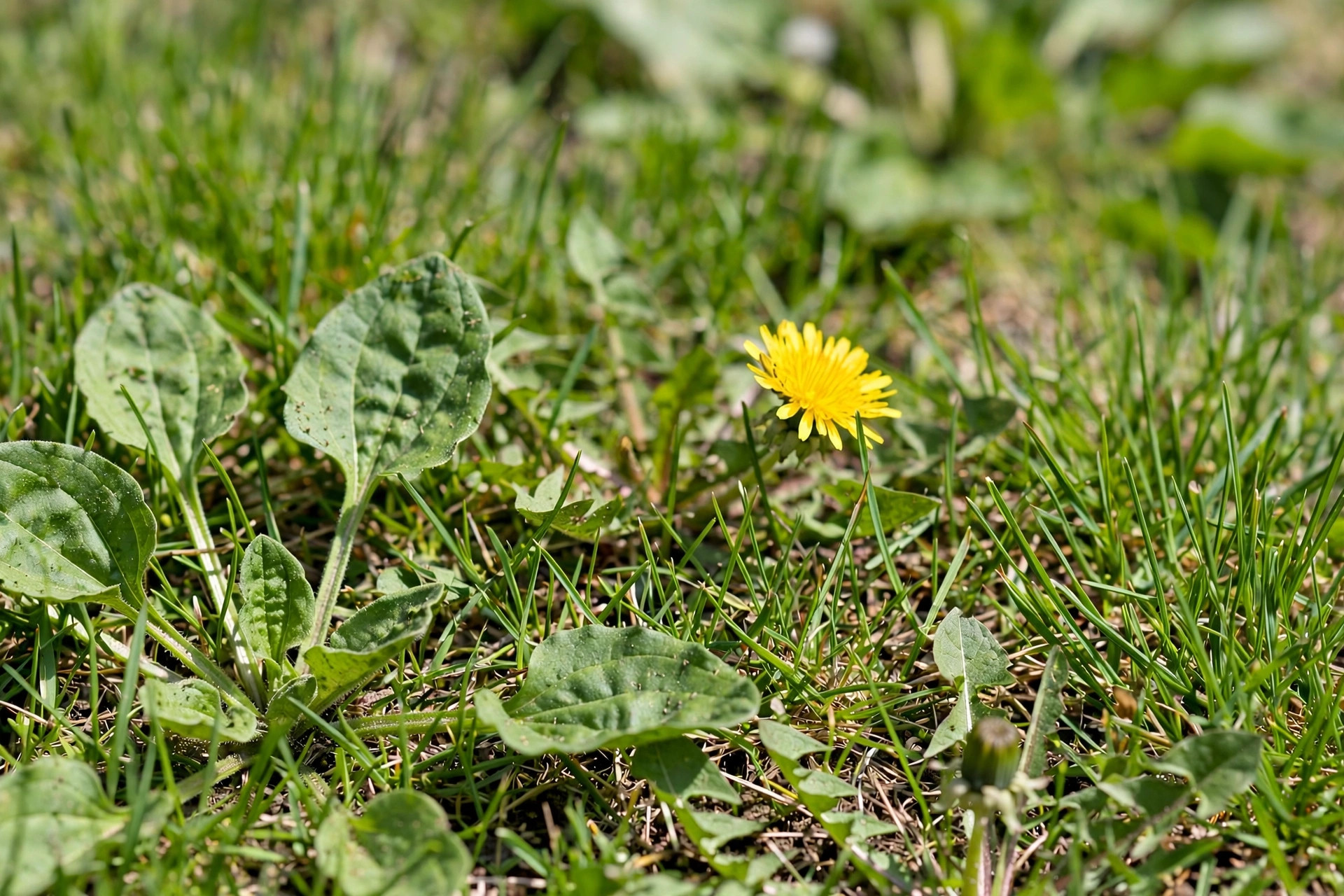
Broadleaf weeds like dandelions, clover, and dollarweed pop up through the growing season wherever the turf is thin. They’re the most visible and the easiest to control — but they keep coming back if the underlying thinness isn’t fixed.
Pre-Emergent vs Post-Emergent: Know the Difference
This distinction is the foundation of all weed control, so let’s make it plain.
Pre-emergent herbicide forms a barrier in the top layer of soil that stops weed seeds from establishing. It must go down before germination — in Central Alabama, that means late winter to early spring for summer weeds, and September to October for winter weeds. It does nothing to weeds already growing.
Post-emergent herbicide kills weeds that are already up and visible. These are the spot treatments and broadcast sprays used through the growing season. They work, but they’re fighting weeds one by one instead of preventing them by the thousand.
A complete weed control strategy uses both: pre-emergent to handle the seed bank, post-emergent to clean up what slips through. Relying on only one is like locking the front door but leaving the windows open.
Why a Program Beats One-Time Sprays
Here’s the math that convinces most skeptics. A single spring spray kills what’s visible in April. But the crabgrass germinating in May, the nutsedge emerging in June, and the Poa annua sprouting in October are all still coming — and that one spray does nothing about any of them.
A weed control program spaces treatments across the season to match weed germination cycles: spring pre-emergent, summer post-emergent rounds, fall pre-emergent. Each visit handles the weeds of that moment while setting up the next one. Over a couple of years, this does something a one-time spray never can: it depletes the weed seed bank in your soil, so there are simply fewer weeds to fight each season.
There’s a practical angle too. Professional-grade pre-emergents and the timing to apply them correctly are the two things homeowners struggle with most. Miss the spring window by a few weeks and you’ve lost the summer. A program puts that timing in someone else’s hands.
What Professional Weed Control Looks Like Across the Year
A solid weed control service in Montgomery County typically follows this rhythm:
- Late winter/early spring: Granular or liquid pre-emergent to block summer annuals, timed to soil temperature rather than the calendar
- Spring: Post-emergent treatment for emerged broadleaf weeds, plus a check on pre-emergent coverage
- Summer: Targeted treatments for breakthrough weeds — dallisgrass, nutsedge, and spurge get special attention since they’re perennials
- Fall: The critical second pre-emergent application for winter annuals, which most DIY efforts skip entirely
- Between visits: A reputable company returns to handle weed breakouts at no extra charge — ask about this before you sign up
Notice the fall application. It’s the single most-skipped step in DIY weed control, and it’s why so many lawns that looked fine in September are full of Poa annua by February.
Fertilization and Weed Control Work Together
It’s no accident that most companies bundle these services. A well-fed lawn grows thick, and thick turf is itself a weed control tool — weed seeds need light and space to establish, and dense grass gives them neither. Fertilization and weed control in Montgomery work as a system: the fertilizer builds the defense, the herbicides handle what gets past it.
This is also why weed control alone can’t fix a thin lawn. If your grass is sparse, killing the weeds just leaves bare dirt — which new weeds will happily colonize. The real fix is weed control plus getting the grass thick enough to hold the ground.
DIY vs Hiring a Pro: An Honest Take
Doing it yourself is absolutely possible. The products are available, and plenty of homeowners in Wetumpka, Cecil, and Hope Hull manage decent results. Where DIY usually falls short is timing and coverage: applying pre-emergent at the right soil temperature, getting even spreader coverage across the whole lawn, and remembering the fall application when life gets busy.
Hiring a pro buys you three things: correctly timed applications, commercial-grade products applied at proper rates, and someone to call when weeds break through between visits. For most busy homeowners, that’s worth more than the cost difference.
The Bottom Line
Weed control in Montgomery is a year-round campaign, not a spring event. Pre-emergent in spring and fall, post-emergent through the growing season, and a thick lawn doing half the work for you. Get that system in place and the weeds stop being a crisis and start being a minor chore.
Want the weeds handled without the calendar-watching? We serve Montgomery, Pike Road, Prattville, Millbrook, Wetumpka, Hope Hull, and Cecil, Monday through Saturday. Call Lawn Care Montgomery for a free quote on a weed control program at (334) 719-0646.
Related reading: for exact timing, see when to apply pre-emergent in Central Alabama, and for the full-season approach, our lawn treatment program guide.
One Comment
Comments are closed.